
Collaboration moving Canadian capabilities from individual components toward deployable infrastructure
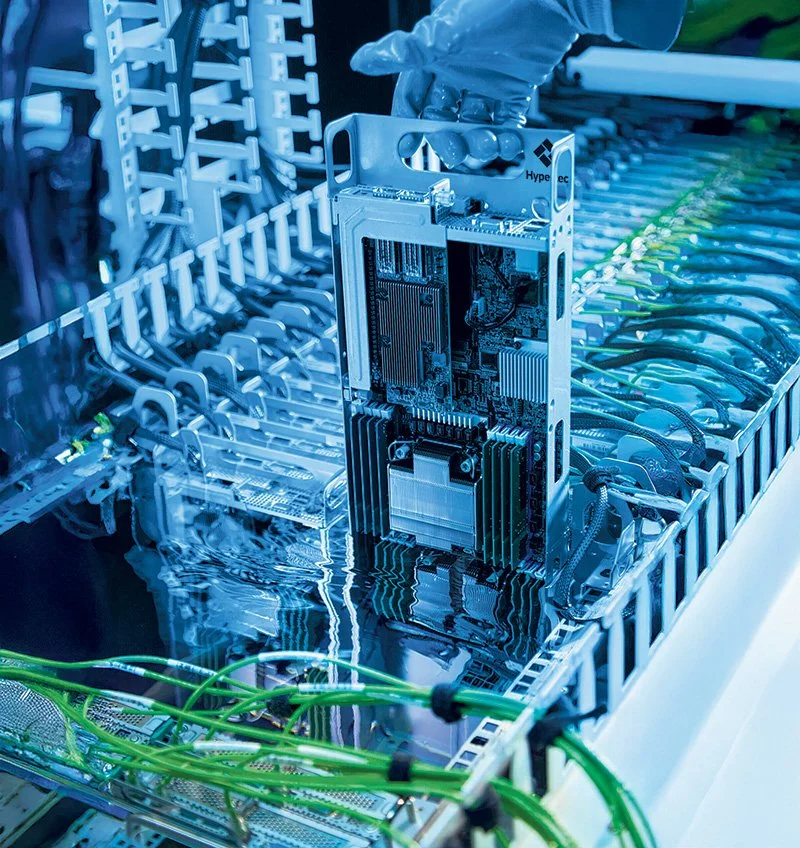
Immersion cooling fluids enable a more effective heat transfer compared to air, and Hypertec engineered its TRIDENT immersion-born servers specifically for immersion. supplied
Discussion around AI capabilities in Canada are prompting debate around how and where to deploy data centres responsibly. At the municipality level, decision-making requires weighing considerations such as energy efficiency, noise, water use and community impact against the economic benefits AI infrastructure can bring.
Investment in innovative technologies can tip the scales, allowing economic benefits and minimizing impact. With the right support, solutions can emerge through collaboration across the digital infrastructure ecosystem.
“Collaboration is critical because no entity or organization holds all the answers,” says Alex Buczek, director, New Business Development, HF Sinclair’s Lubricants & Specialties, an organization that has developed INNOVATE, a Canadian-made single-phase immersion cooling fluid solution.
Collaboration will be front and centre at ALL IN 2026, Canada’s largest AI and tech event in Montreal. “We are excited to demonstrate an immersion system that is a collaboration of Hypertec, Intelliflex and Petro-Canada Lubricants with INNOVATE,” says Mr. Buczek. “Since this combines INNOVATE’s immersion cooling fluid, Hypertec’s immersion-optimized compute platforms and Intelliflex’s modular AI data-centre approach, what attendees will see is an all-Canadian immersion cooling technology solution.”
Cooling has increasingly become a strategic infrastructure issue. “Thermal density is rising faster than most facilities were designed to handle, and no single cooling approach suits every deployment,” says Peter Hanna, vice-president, Engineering & Technology, Hypertec. “Immersion cooling is often suited where space or power is limited or where compute has to run at the edge.”
Yet getting to implementation “depends on the servers, the fluid and the cooling infrastructure being designed with each other in mind,” he notes. “As a Canadian company with more than 40 years of experience delivering data centres and advanced compute solutions, Hypertec engineered its TRIDENT immersion-born servers specifically for immersion, so density and efficiency are there from the start.”
Immersion cooling fluids such as INNOVATE enable a more effective heat transfer compared to air – and reduce reliance on energy-intensive air-cooling equipment. In a single-phase immersion system, servers or computing components are submerged in an electrically non-conductive liquid fluid, which absorbs heat directly from the hardware and carries it to a heat exchanger, where the heat is transferred out of the system.
Due to the close proximity of components, Mr. Buczek says collaboration is a must to ensure cooling solutions function well within technology systems.
“Working with entities like Hypertec, a leader in server technology, is important since we need to understand how servers are designed and optimized for liquid cooling,” he says. “Similarly, managing fluid circulation, heat exchange and dissipation is where leaders like Intelliflex are important for insights on how our fluid technology will interact with server technology and containment systems.”
Key benefits of collaboration are shared learning, aligned technology development and accelerated rollout of new, innovative solutions, says Mr. Buczek, who advocates for “building partnerships early on, to be able to demonstrate mutual interests, alignment and goals.”
He adds, “We work closely with our partners and across the entire ecosystem to understand how immersion fluid cooling can help meet the needs of both the end customer and the overall system.”
A collaborative approach can also bolster supply-chain and ecosystem readiness. Responsible deployment requires compatible fluids, hardware, cooling equipment, modular infrastructure, utilities, controls, operators and service practices – and weakness in any part of the chain can affect performance or reliability.
“One of the biggest challenges with infrastructure projects is simply how many things have to come together at the right time,” says Rodney Briere, president & CFO, Intelliflex. “Power, cooling, site infrastructure, IT capacity – if one piece gets delayed, it can hold up the entire project.”
To address this challenge, “at Intelliflex, we look at the site as a whole,” he says. “Our grid-to-rack approach means we can provide and co-ordinate the infrastructure across the full deployment, which gives us more control over how those pieces come together.”
The approach “makes it easier to solve issues earlier, reduce some of the complexity customers normally deal with, and bring capacity online in phases instead of waiting for everything to be built at once. Ultimately, it gives customers a faster and more flexible path from planning to operation,” Mr. Briere adds.
“We’re proud of our achievement, with all our R&D on INNOVATE and its production based in Canada,” says Mr. Buczek. “We’ve also seen a real willingness among our partners to identify the best way in which we can deliver Canadian-made ingenuity and design for the Canadian consumer and the future of the country.”
As consumers are asking detailed questions about electricity, water, noise, land use and long-term community value associated with data centres, this is an opportunity for Canada to establish a higher standard for deployment: advanced cooling, high-density compute and modular design can help address several of these concerns, but only when projects are engineered as complete systems.
The demonstration unit – jointly designed with Petro-Canada Lubricants, Hypertec and Intelliflex – effectively illustrates how Canadian capabilities can move from individual components toward deployable infrastructure.
“At ALL IN, we’re showing Canadians the potential of this innovative technology,” Mr. Buczek says. “They’ll see first-hand what is possible for taking a more sustainable approach to data centres and AI.”
To view this report on The Globe's website, visit globeandmail.com
To view the full report as it appeared in The Globe's print edition Sovereign computing in Canada