
A resilient water future
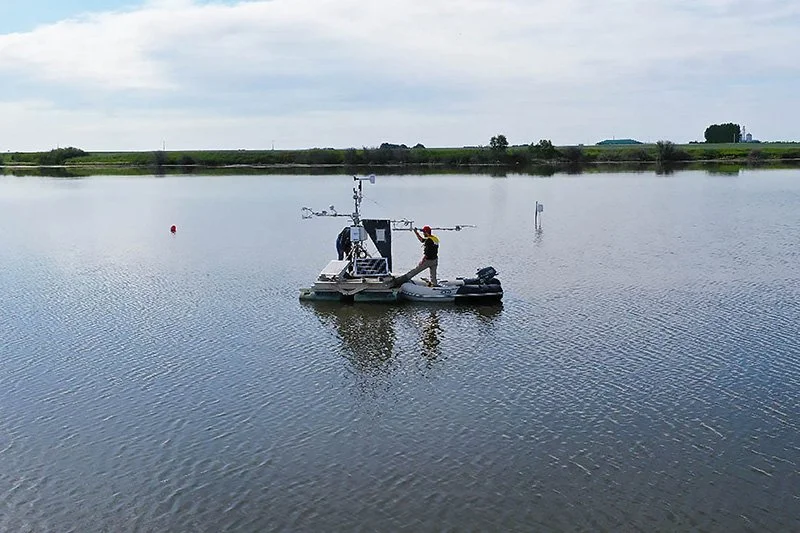
Top: Researchers conduct field measurements to better understand wetland evaporation near Clavet, Saskatchewan. Data collected through water monitoring programs helps improve forecasting and supports informed water management decisions in a changing climate.Phillip Harder; supplied
Strengths in water research causing ripple effects, from Saskatchewan across the globe
This August, widely circulating videos shocked the world. They showed a wall of water, mud and debris engulfing structures and people alike, the result of glacier and rock collapse near Langtang Lirung peak, Nepal. In late June 2026, a state of local emergency was declared in Canmore and Kananaskis, Canada, as heavy rains and snowmelt caused flooding, mudslides and infrastructure damage.
“Canadians often think we have limitless water resources, but that’s a misconception. We have tremendous water resources, but they are not always in the right places at the right time, which makes water management more challenging.”
News cycles tend to capture the public’s attention for only a brief time, yet these catastrophes – along with an uptick in other extreme weather events across the globe – serve as visceral reminders of the dramatic changes affecting our water systems, says John Pomeroy, director of the Centre for Hydrology at the University of Saskatchewan (USask) and Global Water Futures Observatories, a consortium of 12 Canadian universities comprising Canada’s premier national freshwater research facility.
“All over the world, glaciers are in very bad shape,” he reports. In the Canadian Rockies, for example, Peyto Glacier “has retreated over half a kilometre in the last five years,” more than a quarter of its total retreat of about 2,000 metres since 1952.
“Glacier snow and ice play an important role in climate and water systems – and the loss of these glaciers, which is occurring rapidly, has considerable economic, social and environmental impacts,” says Dr. Pomeroy. Climate change, which causes the shorter snow-covered seasons, reduced snowpacks and increased melting that contribute to receding mountain glaciers, also brings consequences for “ice sheets, sea ice and permafrost worldwide.”
Canada’s water resources “are largely derived from such frozen areas,” he says, and the country is far from immune to the impact of “rapid melt of snow and ice, which is leading, in some areas, to water shortages, degradation of water quality” plus changes in weather patterns and landscapes that make them more susceptible to flooding, drought and wildfire incidents.
Building resilience ‘where water and people connect and collide’
Against the backdrop of increased incidence of extreme weather events, Corinne Schuster-Wallace, executive director, Global Institute for Water Security at USask, sees an urgency to explore “what community resilience can look like.”
As Canada sees an increase in “atmospheric rivers, droughts and wildfires, people experience all these changes,” she explains. “When we talk about healthy and safe communities and sectors, being able to withstand these water-related extremes becomes important.”
At the Global Institute for Water Security, this informs an approach that is “about research leadership and water leadership,” says Dr. Schuster-Wallace. “We work to enhance sustainable and equitable water resource management for strong economies; for healthy, safe, secure and prosperous communities – and for ecosystem integrity.”
Water security often describes sustainable access to adequate quantities of safe and clean drinking water. Yet pressures on water systems – including from changes in climate and land use as well as urbanization – can heighten “competition for finite water resources,” she notes. “This affects how we build resilience – and how we ensure sufficient water for communities, economic sectors and ecosystems.”
It starts with acknowledging that “water is, first and foremost, essential for life,” Dr. Schuster-Wallace says. “We need water, we need food, we also need energy. This means we have to think about the big picture.”
Tackling complex global problems, such as water security, is one of USask’s main aspirations, with a strategy that emphasizes cross-disciplinary research and collaborative solutions. “We have researchers looking at the relationships between water, climate, food, energy, health, ecosystems and community resilience,” she says. “This allows us to build a more comprehensive understanding of the complexity that is water, including the areas where water and people connect and collide.”
The making of a water research powerhouse
A cross-disciplinary approach and commitment to collaboration have been among the driving forces for making “water one of our major research stories,” says Baljit Singh, the university’s vice-president, Research. “It’s an area where we have a long track record of research, teaching and community engagement – and where we have been very intentional in trying to create cohesion and impact.”
USask’s Centre for Hydrology, formerly the Division of Hydrology, was established in 1962, “so researchers from across the university – including experts from geology, civil engineering, public policy and remote sensing – could apply their skills to water research,” says Dr. Singh, with decades-long interdisciplinary efforts resulting in “an excellent water research program that has a very meaningful impact not only in local communities but across the world.”
Strong local connections – and appreciation from communities and other partners – provide a solid foundation for “taking the science, the data and the solutions and connecting with a broader community across Canada and around the globe,” he says. “From this excellence, we have been able to build outstanding infrastructure and attract top talent to the University of Saskatchewan, including faculty, staff, graduate students and postdoctoral fellows.”
From the Centre for Hydrology to the Global Institute for Water Security and Global Water Futures Observatories, the resulting momentum has helped “put Canada on the global map when it comes to excellence in water research,” says Dr. Singh, adding that results include world-leading infrastructure and funding support for projects “of a scale that truly inspires strong connections and data-sharing for the benefit of communities.”
This finds reflection in the 2026 ShanghaiRanking Global Ranking of Academic Subjects, where USask ranks number 1 in Canada and among the top 10 globally in water resources.
Made-in-Saskatchewan solutions with global relevance
USask researchers collaborate with colleagues across Canada and participate in global initiatives to advance freshwater and cryosphere sustainability, yet the seed of this far-reaching impact was planted at home, in Saskatchewan, suggests Dr. Singh. “One of the reasons the program is so impactful is because we work with local partners from the start to better understand the problems we’re trying to solve. We don’t just come up with research questions sitting alone inside the university.”
Questions around water resources touch every part of society and all areas of development, for example. “The population of Saskatchewan has grown by 300,000 people over the last 20 years. Here, we’re expanding agriculture and critical mineral production. There have also been announcements about building two nuclear power plants and establishing big data centres,” he says. “Saskatchewanians want to understand: ‘Do we have a sustainable supply of water to accomplish all of this?’”
This cannot be answered without scientific investigation, says Dr. Singh. “What is required is excellence in water research, the infrastructure to support it – and extensive collaboration across disciplines and across institutions – and with partners from communities, industry and government. We then have to ensure our data reaches decision-makers at the local, national and international levels, so it has an impact on policy.”
This is an important step: to ensure research has an impact, agrees Dr. Schuster-Wallace. “It starts with understanding changes in our water systems with a view that the monitoring, forecasting and modelling can support informed decision-making.
“It is all about bridging research, policy and practice – and for that, we need to bring together university, industry, community and government,” she says. “It’s also about bridging Saskatchewan, Canada and the world. We are developing solutions made in Saskatchewan and for Saskatchewan, but they also have global relevance.”
From research to impact
While water security challenges are subject to unique place-based pressures and conditions, a better understanding of these factors can provide insights that are not only relevant for local solutions but also help to illustrate larger trends.
Saskatchewan, for example, faces issues that span increased demand due to population growth as well as agricultural and industrial expansion, infrastructure decay, deeply rooted water-equity concerns, especially in Indigenous communities, and climate extremes.
Water availability relies heavily on flows generated by mountain snowmelt and glaciers, a situation that mirrors many other parts of the world, says Dr. Pomeroy. “Canadians often think we have limitless water resources, but that’s a misconception. We have tremendous water resources, but they are not always in the right places at the right time, which makes water management more challenging.”
Since “we can’t manage what we don’t know, Global Water Futures Observatories play an important role in understanding what is happening in our water systems, including their frozen parts,” he explains. “Whether that’s analysis of the chemistry in the Great Lakes, the melt rate of a glacier in Banff National Park, the thaw of permafrost in northern Canada or declining lake ice cover” – these measurements are key for finding ways for Canadians to adapt to a changing climate.
Global Water Futures Observatories brings together 12 universities, supports hundreds of graduate students and researchers, and provides thousands of users across the country with water data. “It really is the foundation of our knowledge industry focused on water,” he adds.
The importance of “global co-operation on monitoring, projections, adaptation and risk management” was recently underlined when the UN declared 2025-2034 the Decade of Action for Cryospheric Sciences, an initiative, led by UNESCO, in which Dr. Pomeroy chairs the strategic management committee.
“We have strong collaborations in other cold regions, for example, in Central Asia, South America and Europe,” he notes. “Since these are areas where snow and glaciers provide a large portion of water supply, exchanges of information with researchers and governments can help everyone move ahead faster.”
It is this engagement that inspires a degree of optimism in a field of study confronted with critical change for Dr. Pomeroy.
“Emissions reduction is essential to limiting cryospheric loss, while improved observation and prediction can help societies adapt to unavoidable changes,” he says. “By measuring and better understanding these phenomena – and applying scientific principles – we can at least help people find solutions, for example, for water management or improved flood prediction.”
In Nepal, this might mean high-mountain observation and early-warning systems. In Canada, this can be a national flood forecasting system or, at least, better co-ordination of the flood forecasting frameworks that are currently under the purview of provinces and municipalities, for which Dr. Pomeroy advocates.
“We need to be better prepared,” he says, “for the extreme events that are almost certainly coming our way.”
To view this report on The Globe's website, visit globeandmail.com
To view the full report as it appeared in The Globe's print edition Western schools