
Powering progress
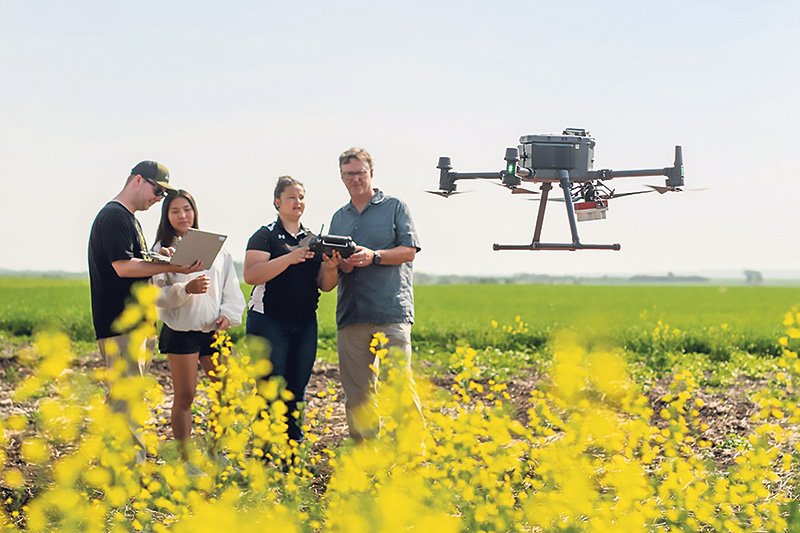
Steve Shirtliffe (right), director of the Nutrien Digital Agriculture Centre at the University of Saskatchewan, works with students and a drone technician during field research. supplied
The University of Saskatchewan catalyzing local strengths for global impact
From the ground, a field of wheat might look remarkably uniform. But beneath that apparent sameness lie differences in soil, moisture and growing conditions that can have a significant impact on what a farmer harvests.
Soon, farming may depend as much on satellites, artificial intelligence and sophisticated data analysis as it does on tractors and combines.
Researchers at the University of Saskatchewan (USask) in Saskatoon are helping make that future a reality through the Geospatial Agroecosystem Inference Generator (GAIG), an ambitious project that combines satellite imagery, weather records, soil information and artificial intelligence to create a digital twin of Western Canada’s farmland, detailed enough to reveal variations across areas just 10 metres wide.
For farmers, the possibilities are intriguing. Rather than treating an entire field as though conditions are identical from one end to the other, they could identify underperforming areas, manage sections differently or make more informed decisions about fertilizer use. The potential payoff includes lower costs, more productive farmland and less environmental impact.
The project is part of the work underway at USask’s Nutrien Digital Agriculture Centre, supported by a $15-million gift from Nutrien that is also helping develop the kihci-okâwîmâw askiy (Great Mother Earth) Knowledge Centre, a space for collaboration and engagement with Indigenous communities.
Nutrien’s relationship with USask stretches back to its days as PotashCorp. Today, as the university’s largest corporate donor, it is helping accelerate research and innovation while developing the expertise and talent needed for the future of agriculture.
For USask, the Nutrien partnership illustrates a larger ambition: to bring together the university’s research expertise and the resources of industry, governments and philanthropists to solve problems neither could tackle as effectively alone.
Where different strengths meet
“USask is deeply connected to the sectors that are shaping Canada’s future,” says Vince Bruni-Bossio, the university’s president and vice-chancellor. “Food production, water security, energy, critical minerals and health are not abstract research topics here. They’re part of the province’s economy and daily life.”
As Saskatchewan’s only member of the U15 group of research-intensive universities, USask combines specialized facilities and research expertise with close connections to industries that can put discoveries to work.
Investing in the capacity to grow
A recent economic impact study found that USask contributes approximately $2-billion annually to Saskatchewan’s gross domestic product and supports more than 13,000 jobs, directly and indirectly. Every dollar the provincial government invests in USask generates an estimated $3.64
in GDP.
For Deirdre (Dee) Henne, USask’s chief financial officer, those figures demonstrate both the university’s economic contribution and the importance of maintaining the financial strength needed to invest in its future.
“We’ve worked hard to build a strong financial foundation, and that puts us in a position to invest strategically in our students, our research and the facilities Saskatchewan will need in the years ahead,” she says.
The provincial government has approved a $250-million bond that will allow USask to renew infrastructure and expand student facilities as Saskatchewan prepares for a growing population of young adults entering post-secondary education.
“We’re looking closely at population projections and labour-market needs so we can invest where Saskatchewan will need us most,” says Ms. Henne. “That means making sure we have the capacity to educate the next generation of engineers, business leaders, accountants, doctors, dentists and other professionals.”
Planned investments include a second cyclotron to produce medical isotopes for health-care providers in Saskatchewan, Alberta and Manitoba and beyond, creating opportunities for skilled jobs and new revenue.
USask is also exploring alternative revenue through its extensive land holdings, including residential communities, commercial developments and health-care facilities that could generate income for reinvestment in education and research.
“We’re not investing simply to expand the university,” says Ms. Henne. “We’re investing in the expertise, facilities and opportunities Saskatchewan will need in the years ahead. And we’re finding new ways to generate the resources that will allow us to keep doing that.”
More than a financial transaction
For Kimberly Kroll-Goodwin, USask’s interim vice-president of university relations, the strongest partnerships begin with a shared problem to solve.
“We’re seeing a real shift in what corporations and philanthropists want from their investments,” she says. “Supporting students remains enormously important, but increasingly, partners are looking to tackle tough, real-life challenges in food security, health care, energy and other areas. They’re looking for expertise and solutions, not simply somewhere to direct their philanthropic dollars.”
That approach is reflected in a $10-million commitment from Saskatchewan-based uranium producer Cameco. The investment is helping advance a Nuclear Fuel Cycle Program and a new certificate in Energy and Resource Management, bringing together engineering, energy research and policy expertise to help prepare the skilled workforce and knowledge base needed by Canada’s evolving nuclear sector.
“These are programs we can move forward much more quickly because of the partnership,” says Ms. Kroll-Goodwin. “It allows us to bring different disciplines together and develop the knowledge and talent that an industry needs to succeed.”
She believes Saskatchewan has a particular advantage when it comes to building these relationships.
“I grew up in small-town Saskatchewan, where neighbours helped neighbours,” she says. “That spirit carries through to the way we work with our partners. We take the time to understand what matters to them and what they’re trying to achieve, then find where our strengths and their ambitions meet. It’s about shared purpose, not just a financial transaction.”
As it develops its next strategic plan, UPlan 2035, USask is also meeting with business and industry leaders to understand the challenges they face, the skills they need and the opportunities emerging from technologies such as artificial intelligence.
From Saskatchewan to the world
USask’s partnerships are reaching beyond Canada’s borders. For example, the university is working with governments and academic institutions in India to explore the creation of a Canada–India Pulse Protein Centre of Excellence, building on Saskatchewan’s expertise in pulse crops to advance food research and address international food security challenges.
“Part of the university’s role is to think beyond the next quarter or even the next decade,” says Dr. Bruni-Bossio.
For companies focused on immediate challenges, governments confronting changing demands and donors hoping to make a lasting difference, that longer view offers something distinctive.
“We’re not simply looking for investment in the University of Saskatchewan,” says Dr. Bruni-Bossio. “We’re looking for partners who share our ambition to solve problems that matter. When we combine their resources and experience with our research expertise, we can achieve things that none of us could accomplish alone.”
To view this report on The Globe's website, visit globeandmail.com
To view the full report as it appeared in The Globe's print edition The Saskatchewan advantage