
Pathways to AI adoption
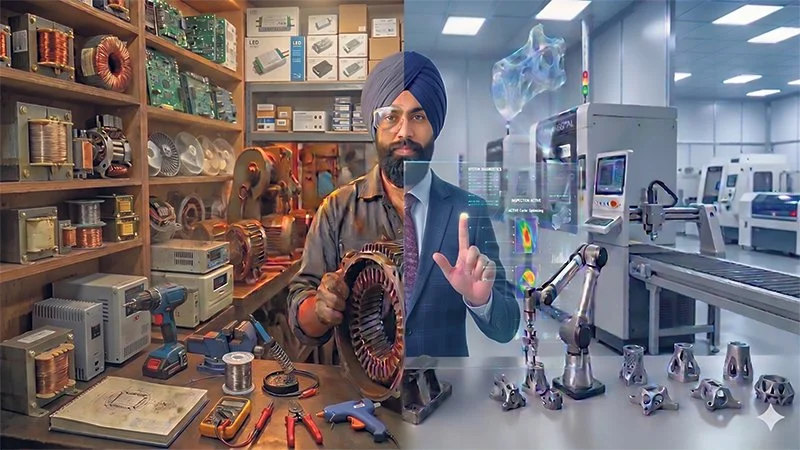
Applied research partnerships at RRC Polytech’s Centre for Automation and Manufacturing Technology Transfer provide businesses with a path to impactful AI adoption. supplied
Mustering a strong and timely response to industry needs at RRC Polytech
Canadian manufacturers have access to AI but may miss stepping stones on the pathway for making it work for them.
There is a gap between the promise of automation and the practical work of making it function on a production floor, says Baltej Singh Rupal, Research Chair in Advanced Manufacturing and Mechatronics at RRC Polytech, where he leads the Centre for Automation and Manufacturing Technology Transfer (CAMTT), the applied research arm of the Price Institute of Advanced Manufacturing and Mechatronics.
“The bottleneck is rarely the algorithm,” he says. “It is the absence of someone who can stand on the floor, understand the physics of the process and build a solution that the operator can actually trust.”
“The bottleneck is rarely the algorithm.It is the absence of someone who can stand on the floor, understand the physics of the process and build a solution that the operator can actually trust.””
The distinction between inventing and translating technology is, in Dr. Rupal’s view, where polytechnic labs excel. “Applied research is responsive and can provide fast results compared to more fundamental research approaches,” he says. “You don’t have to wait years and years.”
For AI, this can mean adapting established tools to a factory’s specific problem rather than developing an entirely new system from scratch. Companies bring real production problems to CAMTT, and the team works toward practical solutions: an applied research route that allows a quick and robust response to industry needs.
The focus is on technologies that exist but aren’t yet widely adopted on Canadian factory floors, for example, additive manufacturing, advanced robotics, industrial IoT and now AI-enabled vision systems. A recurring challenge is high-mix, low-volume production, where product lines change constantly and off-the-shelf automation struggles to keep up, notes Dr. Rupal. The aim is to develop vision systems that can accommodate changing production runs without costly reprogramming each time a product changes.
Price Electronics is one example. Working with CAMTT, the Manitoba-based manufacturer is developing a trainable automatic vision system (TAVS) to tackle a bottleneck in the manual inspection of custom microelectronics. The project is still underway, but CAMTT anticipates inspection time could fall by more than 50 per cent, while improving the reliability and accuracy of quality control.
A small or mid-sized manufacturer would struggle to build that alone, and the cost and risk of unproven automation keep many from trying. That’s the kind of problem polytechnics are uniquely positioned to solve, says Dr. Rupal. “The opportunity for de-risking in terms of adopting a new technology through applied research is not there elsewhere. Polytechnics are one of the only avenues apart from direct government grants.”
A company can bring CAMTT a problem and test a solution in a lower-stakes environment before committing capital at scale, reducing the risk of investing in technology that may not fit its operations, he adds.
None of this happens without infrastructure. CAMTT has robotic trainers, PLC training sets, 3D printers, sensors, AI computing capacity, a waterjet cutter, a laser cutter and an injection-moulding machine. It also draws on equipment and expertise shared across RRC Polytech’s Research Partnerships and Innovation (RPI) network, giving manufacturers access to tools that would otherwise be difficult, and sometimes impossible, to afford alone.
The centre’s projects also give students hands-on experience with the equipment and industrial problems they will encounter in the workforce.
This model can travel well beyond Manitoba, where polytechnics can help manufacturers test and adopt technologies without asking individual companies to absorb the full cost and risk, he adds. “CAMTT shows that applied research done in response to industry can move at the speed manufacturers need.”
To view this report on The Globe's website, visit globeandmail.com
To view the full report as it appeared in The Globe's print edition Excellence in research & innovation