
Quantum-powered progress
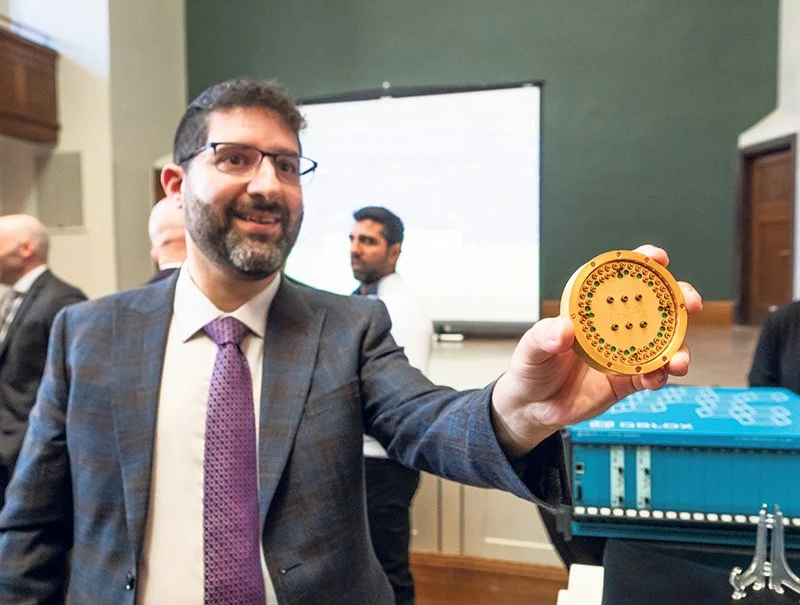
Steven Rayan, professor of mathematics and statistics and director of the University of Saskatchewan (USask) Centre for Quantum Topology and Its Applications (quanTA), holds up one of two quantum processing chips that will power the first university-owned-and-operated, vendor-supported, full-stack, open-architecture quantum computer in Canada. Matt Smith/University of Saskatchewan
Canada’s first full-stack, university-owned quantum computer opening new horizons at the University of Saskatchewan
The small disc – similar in circumference to a hockey puck – represents the culmination of decades of research, innovation and collaboration. It also holds tremendous promise for the future.
While some outcomes are envisioned as faster vaccine development, better crops for food security, stronger insights for health care and business performance, other achievements are “yet to be imagined,” says Steven Rayan, professor of mathematics and statistics and director of the University of Saskatchewan (USask) Centre for Quantum Topology and Its Applications (quanTA).
Excitement is writ large across Dr. Rayan’s face as he holds up what he jokingly calls “Canada’s most expensive hockey puck,” one of two quantum processing chips that will power the first university-owned-and-operated, vendor-supported, full-stack, open-architecture quantum computer in Canada.
Housed at USask, it will expand quanTA into a major hub for quantum innovation, he says. “I’m holding 14 superconducting quantum bits, or qubits, in my hand. I’m also holding the results of a million dollars of investments, made possible by our immensely generous federal and provincial funders and partners. It has Canada written all over it.”
For USask President Vince Bruni-Bossio, the quantum computer affords USask a place among the small group of universities globally that have such technology on site – and a key role in advancing Canada’s quantum strategy.
“Quantum computing is reshaping how we approach big and complex problems in a rapidly changing world,” Dr. Bruni-Bossio says. “Being able to apply quantum tools to solve such challenges gives us the ability to lead. Rather than investing in a machine, we’re investing in the capacity to innovate and solve problems – and contribute in more impactful ways in areas that are important to Canada and the world.”
A qubit-powered quantum leap
Dr. Rayan sees USask’s acquisition of the quantum computer as “a real game changer for the university, the province, the Prairies and Canada” since the significance of the resulting leap forward can be compared to “the transition from the candle to the light bulb.”
But what makes a quantum computer so different? An ordinary computer contains a multitude of tiny on-off switches called bits, in which all information “contained in an email or a video file, for example, has to be encoded,” explains Dr. Rayan. “A lot of technological innovation has gone into improving these switches to make them fast enough to process complex information.”
Quantum computers, in contrast, contain quantum bits, which are not on-off switches but dimmer switches, that “can be on, off or anything in between,” he says. “This ‘anything in between’ may not sound revolutionary, but it enables capabilities far beyond those of ordinary computers. In some sense, one quantum bit is worth more than the billion bits in your computer.”
To illustrate this quantum leap, Dr. Rayan suggests thinking back to a time, around 1950, when there were significant doubts, at both public and industry levels, about the value of computers.
“Fast forward to now, when many have a computer on their desk, a laptop in their bag and a phone in their pocket. Today’s world would have been unimaginable even a few decades ago,” he says. “The world that is coming – enabled by capabilities gained from quantum computing – is similarly unimaginable.”
Supercharging discovery
Qubits enable massive parallel processing to solve complex, calculation-heavy tasks. This allows a quantum computer to perform in seconds what might take a conventional computer years to calculate, a capability that “enables outcomes that are otherwise impossible,” says Dr. Rayan, who gives the example of tackling emerging pathogens of concern.
For COVID-19, “it took us a bit less than a year – months and months of intense research – to get a viable medical intervention in the form of a vaccine. For the future, the World Health Organization has set the goal to have a vaccine within 100 days,” he says. “My goal would be having a vaccine in 100 minutes.”
The idea is to leverage the quantum computer’s capability of simulating a multitude of vaccine candidates “to select the ones most likely to be effective – before further testing,” he adds. “This can help save time and energy in service of the public good.”
In this scenario, quantum computing can accelerate vaccine discovery through collaboration between quantum computing teams and experts from USask’s Vaccine and Infectious Disease Organization (VIDO), a world-leading facility in infectious disease research and vaccine development.
Agriculture is another area where quantum science can bring substantial benefits, for example, by predicting plant performance, says Dr. Rayan. “From a plant’s genome, we try to understand whether it is going to be a robust, resilient and bountiful crop. Where agriculture meets quantum computation is in being able to pick out the best candidates before you invest in growing the crops.”
By combining research and innovation strengths from different areas of expertise at USask, for example, with VIDO, the Global Institute for Food Security and the Global Institute for Water Security, “we can enhance what we are already good at – and achieve outcomes that are greater than the sum of their parts.”
In addition to “operationalizing the quantum computer to realize benefits across the entire academic landscape, it is also a vehicle for strengthening existing partnerships and making new kinds of connections,” proposes Dr. Rayan.
He envisions collaborating with health-care agencies for a leap forward in understanding – and protecting – health data as well as working with companies of all sizes to unlock operational benefits from data analytics capabilities out of reach with current technologies, including AI.
Homegrown innovation with an international perspective
Funding of $1.93-million and $400,000 for the quantum computer came from Prairies Economic Development Canada through the Regional Innovation Ecosystems program and Innovation Saskatchewan through its Innovation & Science Fund, respectively.
“It’s an example of an academic, government and industry partnership,” says Dr. Rayan. “We collaborated with four incredible industry partners: Rigetti Computing, Qblox, QuantrolOx and Zero Point Cryogenics, with additional support from Testforce Systems.”
It is deeply meaningful for Dr. Rayan that two of the partner companies have Canadian roots and are connected to the Prairies: Rigetti Computing and Zero Point Cryogenics.
Rigetti, which built the chip at the heart of the quantum computer, was founded by Moose Jaw’s Chad Rigetti, while Edmonton-based Zero Point Cryogenics contributed “the dilution fridge that brings down temperatures to colder than outer space, which are necessary for this computer to work,” he says. “Once it is on, you could be standing next to one of the coldest points in the universe.”
Qblox and QuantrolOx contributed control hardware and software.
“This deep tech was built with a Saskatchewan perspective, but it is also a truly international partnership, with Canada, the U.S., the U.K., Netherlands, Finland and Switzerland all represented in this consortium of companies,” Dr. Rayan notes. “It is a worldwide project brought to life in Saskatchewan, with federal and provincial funders coming together with USask to have this international technology here.”
Local impact, global responsibility
Support for the quantum computer represents “a vote of confidence” for USask’s reputation for research excellence as well as the strong partnerships the university has forged “with industry, communities and government,” says Dr. Bruni-Bossio. “Our connection with Saskatchewan is one of the strengths that gives us the ability to lead on the world stage.”
As USask gains a competitive edge in quantum science, this doesn’t happen in isolation, he notes. “We are part of the Prairie Quantum Corridor led by the University of Saskatchewan and the University of Calgary. Connecting our expertise, infrastructure and talent across the Prairies in a quantum ecosystem allows us to support national priorities such as driving Canada’s innovation agenda forward.”
Innovation is key for realizing Canada’s ambitions to bolster productivity and competitiveness, and Dr. Bruni-Bossio emphasizes that collaborations drive stronger outcomes.
“When we approach things as a region or a country rather than as separate institutions, we create the opportunity to solve problems together,” he says. “Talking about community may focus on Saskatchewan, the Prairies or Canada, but we’re also part of the global community.”
As the world faces urgent challenges that require answers and solutions, “operating as a community at the local level can serve as a role model for how we can work together around the world,” says Dr. Bruni-Bossio. “By housing this quantum computer here at the university, we’re building capacity that serves Saskatchewan, the Prairies and the country, but we also have a responsibility to play a role in solving global problems.”
Training next-generation quantum talent
With the quantum computer, USask continues a legacy of building world-leading research infrastructure and driving innovation, says Dr. Bruni-Bossio. “This allows us to attract top talent and provides opportunities where researchers and students can work in partnership with communities, industry and government. And it enables training and experimentation, where students get hands-on experience for dealing with quantum issues.”
At USask, almost 20 professors focus on quantum research – and between 60 and 100 graduate students work on a range of quantum topics with different mentors and supervisors. Dr. Rayan predicts a considerable impact.
“Computers were one of biggest and best innovations of the 20th century,” he says. “We are now facing another disruptive moment, in the most positive sense of that term, with this 21st century technology that builds on the vast and rich ecosystem and talent at places like the University of Saskatchewan.”
It is also a personal milestone for Dr. Rayan. “I started studying quantum science about 25 years ago. As a student, I dreamt of something like [this quantum computer],” he says. “While it has been a very gratifying journey, I am thrilled that today’s students don’t have to wait 25 years to get hands-on experience with this technology.
“Quantum computing has sometimes been described as a shortcut in time, and I can’t wait to see what the next generation will achieve.”
To view this report on The Globe's website, visit globeandmail.com
To view the full report as it appeared in The Globe's print edition Western schools