
From idea to impact
Leveraging research excellence to develop solutions to urgent global challenges
The Earth’s biosphere reached a notable milestone in 2020, when anthropogenic mass – the sum of all human-made things like buildings, infrastructure, cars and cellphones – started to outweigh all living things.
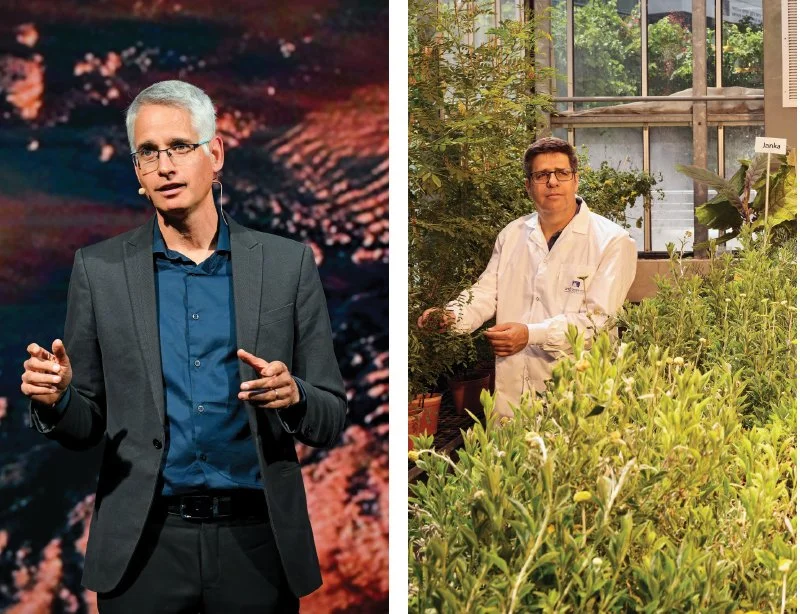
The premise that quantitative analysis can enable a more in-depth understanding of nature – and point the way to potential solutions – inspires efforts to create “a census of life on Earth” by the Institute for Environmental Sustainability (IES) at the Weizmann Institute of Science, says Ron Milo, dean of education and IES director, who applies big data analysis tools to use numbers to understand and explain the world.
“In a world that is so big and varied, it is challenging to comprehend our biosphere and how much we, humanity, are changing it,” he notes. “So, the idea is to convey a more intuitive sense through quantifications that enable comparisons like the weight of living things versus anthropogenic mass.”
Arriving at such eye-opening numbers represents “a way for science to move out of the lab to where it can resonate with the larger public,” says Dr. Milo, whose lab employs a combination of computational and experimental synthetic biology tools to investigate the fundamental design principles of carbon fixation and photosynthesis, with the goal of improving the efficiency of food and chemical production.
“Our motivation is to find breakthrough solutions to urgent problems, and this requires working with the best possible researchers and giving them the freedom to follow their curiosity and opportunities to collaborate,” he says, adding that the range of sustainability-related efforts at the IES includes “renewable energy, sustainable materials, food security, health and nutrition, climate research, marine research, and biodiversity and ecosystems.”
The goal “to use applied science to design the food of the future” is what inspires Asaph Aharoni, head of the Department of Plant and Environmental Sciences, whose work, over the past several years, informed eight startup companies that offer myriad solutions for agriculture and food production. One example is his research on metabolites, which led to the development of natural plant-based pigments called betalains and the startup company Phytolon, which produces them through large-scale yeast fermentation.
“Plants make an amazing diversity of structures – and some of them are colourful,” says Dr. Aharoni, explaining that the vibrant colours of fruit and vegetables are primarily driven by specialized plant metabolites, such as anthocyanins, carotenoids and betalains, colourful compounds that not only provide visual appeal but also act as powerful antioxidants.
“Our goal is to understand the role of pigment in plants and the genetics behind the chain reaction that leads to the formation of these metabolites,” he says. Of particular interest are the biochemical pathways that produce plant specialized metabolites, chemicals that plant species produce to cope with changes and stress in their environment.
“Our motivation is to find breakthrough solutions to urgent problems, and this requires working with the best possible researchers and giving them the freedom to follow their curiosity and opportunities to collaborate.”
Understanding these biological processes can also lead to practical applications, for example, for fighting world hunger and malnutrition, investigating psychoactive ingredients for biomedicine and developing sustainable sources of plant-based materials.
One area of impact is to help reduce reliance on synthetic food ingredients, suggests Dr. Aharoni. “About 60 per cent of food colourings are artificial. Not only is their production harmful to the environment, but they are unhealthy, so many countries are moving to ban synthetic food additives.”
With cutting-edge high-resolution mass spectrometry techniques and specialized computational and experimental biology tools, Dr. Aharoni’s lab has compiled substantial metabolite databases, including one covering genetic and metabolic traits of both wild and cultivated tomatoes. This information has been used to understand the correlation between genes, metabolism and other traits, allowing scientists and breeders to produce the next generation of tomato varieties.
By transplanting pieces of DNA from red beet into potato and tomato plants, for example, the team created “a super colourful red tuber and a small cherry tomato called Micro-Tom, which are now both able to produce betalains,” he says.
Dr. Aharoni and his colleagues are also exploring ways for using natural pigments for dyeing textiles, creating plant-based alternatives to glue and more.
“Both the pigment industry and the glue industry are damaging to the environment and create health concerns, so our idea is to replace these [synthetic] materials,” he says. “Our lab is doing lots of different research to make our world healthier and more sustainable.”
Dr. Milo draws optimism from how research insights can help transform society. “We’ve already seen the impact of technologies like the ones we’ve been working on at Weizmann,” he says. “For example, photovoltaics is now one of the cheapest and best ways to produce electricity; and about 70 per cent of Israel’s domestic water consumption comes from desalination. We took really thorny problems and used science and technology to bring about a transformation.”
Ongoing work at the IES promises similar game-changing results. In addition to Dr. Aharoni’s trailblazing research on food systems, Dr. Milo mentions investigations into how to recycle rare earth elements, as well as new ways for using electrochemistry to produce fertilizers or store carbon.
Research excellence has earned the Weizmann Institute a leadership position in such efforts. Ranked sixth globally for overall research quality, as measured by the 2025 Leiden ranking, Weizmann sits alongside MIT, Princeton, Caltech, Harvard and Stanford. In a Nature Index special report ranking the top 200 institutions by innovation, the Weizmann Institute ranked sixth for third-party patents and fifth for its own patents, the only non-U.S. institution in the top 10.
“In many ways, we’re a generation with near-superhero powers that allow unprecedented access to food, energy and means of communication,” sums up Dr. Milo. “However, we’re also facing great challenges on a global scale due to climate change. This makes it all the more important that we find more solutions – and make sure they are readily available.”
To view this report on The Globe's website, visit globeandmail.com
To view the full report as it appeared in The Globe's print edition