
From wildfire research to real-world solutions
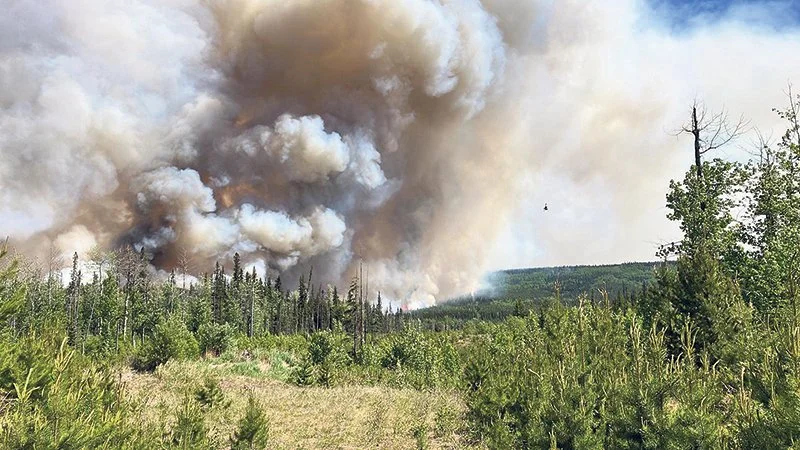
Wildfire risk is a global problem, with changing conditions leading to longer and more intense fire seasons in many areas across the world. Responses, however, have to be both place-specific and dynamic, proposes Jill Harvey, Canada Research Chair in Fire Ecology, Faculty of Science, Thompson Rivers University (TRU).
“Tackling the challenge of wildfires requires pathways that allow us to not only deal with the current situation but also be prepared for the future,” she explains. “Wildfire is a big problem that can’t be solved by a single solution. What we need are interdisciplinary approaches and partnerships that ensure research can be translated into tools and recommendations that are meaningful and can be well applied.”
At TRU Wildfire, the leading national hub for wildfire research, education, training and innovation, this starts with intentional project design, says Dr. Harvey. “If we want to address some of the most pressing questions, we have to bring together different voices, such as academic researchers, forest managers, policymakers, other practitioners and community members.”
“Wildfire is a big problem that can’t be solved by a single solution. What we need are interdisciplinary approaches and partnerships that ensure research can be translated into tools and recommendations that are meaningful and can be well applied. ”
A collaborative approach brings the ability to draw on local knowledge as well as identify matters of concern for communities. For example, in a recent graduate student research project with the Ulkatcho First Nation, located in the West Chilcotin of British Columbia near Anahim Lake, “the focus of the community was on the impacts of wildfire on caribou habitat,” she notes. “We came together and designed a research question based on community priorities.”
The ranges of four herds of caribou overlap with Ulkatcho territory, and an uptick in prevalence and size of wildfires over the past 20 to 25 years raised questions about habitat recovery, says Dr. Harvey, who led a team of graduate and undergraduate students to visit sites of wildfires that happened over the past 100 years.
“We took measurements of terrestrial and arboreal lichens, primary food sources for caribou. We also studied stand structure and density in forests that were regenerating after a wildfire,” she says. “We found that such forests were very dense, with a tree count of about 7,000 to 9,000 stems per hectare. I stood in these forests 40 years after a wildfire, and because of the density of the stands, I could hardly move.”
Research insights were illuminating. “We generally think that landscapes with lodgepole pine-dominated forests have somewhat recovered 40 to 60 years after a wildfire, but it can take upwards of 60 years for lichens to re-establish and grow,” states Dr. Harvey. She added that when this is considered together with the dense regenerating forests, caribou habitat recovery can take 60 to 100 years. This realization inspired questions about potential interventions, such as whether recovering forests could be thinned without extensive damage to terrestrial lichens, to support forest and habitat recovery.
History and Indigenous knowledge providing clues about wildfire resilience
“When we see more wildfire activity, both in number and size, this is concerning for British Columbians and Canadians,” says Dr. Harvey. “We’re all impacted, whether directly, by having to evacuate, or indirectly, through the effects of smoke or seeing devastation on the news.”
Research of forest ecosystems – at the intersection of ecological, climatic and human-driven factors – can provide valuable insights into what makes landscapes more resilient. By studying dendrochronology, the method of dating and interpreting past climate and events through analyses of the annual growth rings of trees, she learned that “in the dry interior forests of British Columbia, fire was a frequent visitor.
“Looking at history can give us insights into how people and forests interacted – and how climate variability and extreme events impacted forests in the past,” says Dr. Harvey. “Generally, this region has many species and landscapes that were historically resilient to wildfire.”
In the Churn Creek Protected Area in British Columbia, for example, she notes that “records spanning six centuries show that wildfires occurred in the landscape every 15 to 25 years and that, until about 100 years ago, this was likely an open forest with big Douglas fir trees and a grassy understorey.”
Over the past century, however, fuel density in these forests increased, in part due to fire suppression and forest management practices, and Dr. Harvey says this contributed to the intensity of the 2021 Churn Creek wildfire, where a single fire event consumed most of the trees she had sampled.
“When a forest that had been resilient to fire in the past succumbs to a single wildfire, this points to changes in the landscape,” she says, adding that Indigenous knowledge about how to effectively coexist with wildfires can help guide management decisions. “For thousands of years, Indigenous communities used fire frequently as a tool to steward landscapes, including for bolstering resilience to wildfire. If we can weave Indigenous knowledge with western scientific approaches, we can use a more balanced view to manage our resources and landscapes.”
From interdisciplinary collaboration to comprehensive solutions
For the vision of TRU Wildfire, “taking an interdisciplinary approach – where forest ecologists work with experts in fire behaviour, community engagement, social justice and more – is very important,” says Dr. Harvey, who points to a recent visit to Jasper, Alberta, a community devasted by a 2024 wildfire, as an example.
Insights into how the Jasper fire progressed, including through an ember shower that penetrated into the community, can inform measures for increasing resilience, such as “reducing fuel in the wildland-urban interface, creating suitable buffer zones and following FireSmart principles,” she says. Due to the complexity of wildfire recovery, the TRU delegation also included team members “from videography and visual storytelling, social justice, wildlife ecologists and experts focused on recovery and tourism.”
Some projects are collaborations among TRU experts from different disciplines while others include external partners, says Dr. Harvey. “At TRU Wildfire, strong connections, including with the BC Wildfire Service, the Canadian Interagency Forest Fire Centre and local communities, are important to ensure our research projects have a meaningful impact.”
She adds, “One of the biggest differences we make is by giving students the opportunity to learn about ecosystems and wildfires – and about working with communities and other partners to share knowledge in many different ways.”
To view this report on The Globe's website, visit globeandmail.com
To view the full report as it appeared in The Globe's print edition Wildfire resilience