
More effective hair restoration techniques inspiring younger men and more women to seek treatment
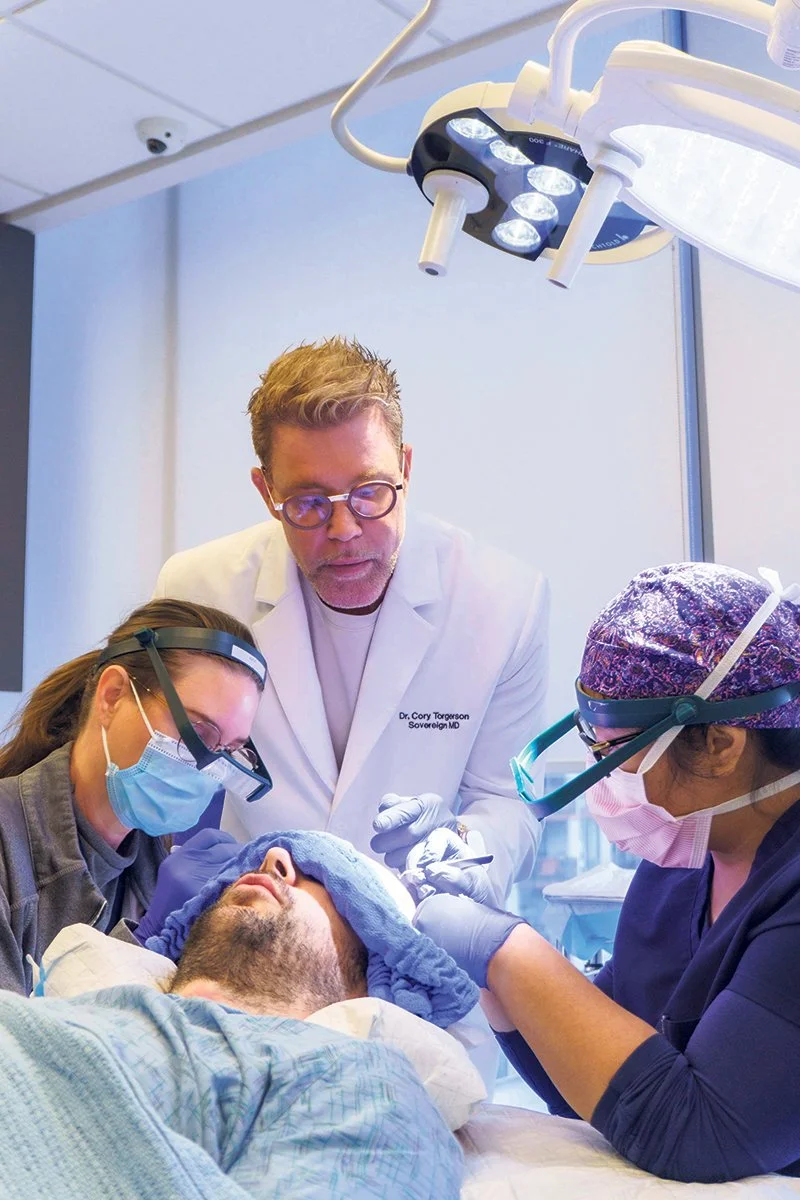
(Left) Dr. Cory Torgerson of The Toronto Hair Transplant Clinic and team perform hair restoration procedure. supplied
Hair restoration is a rapidly expanding field, as new techniques offer less invasive procedures and produce more effective, natural-looking results.
Propelled by new and emerging options for easy-to-undergo surgeries and non-surgical treatments, men are seeking services at younger ages than ever before, with an increasing number of women also undergoing hair restoration.
The growth trends are certainly evident at The Toronto Hair Transplant Clinic, which has been operating in the city since 2015.
“Several years ago, men often waited until their 40s or 50s to do something about their thinning hair,” says Brian Kessler, director of operations at the clinic. “These days, the younger generation, men in their 20s and 30s are our largest clientele for hair transplant. We’ve seen a shift toward proactive hair loss management, seeking treatment earlier rather than waiting until hair loss becomes severe.”
“We’ve seen a shift toward proactive hair loss management, seeking treatment earlier rather than waiting until hair loss becomes severe. ”
More women are also coming to The Toronto Hair Transplant Clinic for hair restoration, Kessler adds. “Women now make up about 15 per cent of our patients. Women are somewhat older, as hair loss affects them most frequently around the time of menopause.”
One factor behind the expansion is the fact that the historic stigma around hair loss and transplants has considerably declined. Today’s society has normalized talking openly about hair loss and transplants, and cosmetic procedures, in general.
And the technological advances in hair restoration methods are making people more willing to seek treatment.
“Advanced methods like Follicular Unit Extraction (FUE) leave minimal scarring and allow for faster recovery times, with many patients returning to work within days,” says Dr. Cory Torgerson, a head and neck surgeon who heads the medical team at the clinic. “People who might have felt intimidated in advance tell us that the procedure was remarkably easy to undergo.”
FUE is the method used for hair harvesting; the technology systems (machines) used for FUE by the clinic’s team are called Smartgraft and Neograft. These are devices operated by experienced medical professionals to harvest the hair (often from the back or sides of the scalp), with the harvested hairs then replanted by hand in the area of hair loss.
Another innovative treatment is platelet-rich plasma (PRP) therapy. In this technique, the patient’s blood is withdrawn using a kit and then spun in a centrifuge to separate out white blood cells. The cells are injected into the scalp to stimulate hair regrowth.
IMPROVED SELF-IMAGE AND
CONFIDENCE
International research shows that the prime motivations for hair restoration are to feel more attractive and to look younger. The kind of transformation that treatment produces boosts people’s confidence in many areas of their life, says Kessler, saying that restoration is more than a cosmetic change but often a restoration of a person’s “ideal self.”
“In my consultations with patients, I often compare hair loss to weight gain,” he says. “Hair loss means you are losing something that made you ‘you.’ The impact is similar to how you perceive yourself if you gain a lot of weight and seek to lose it. In both cases, you are motivated to restore your ideal self.”
To view this report on The Globe's website, visit globeandmail.com
To view the full report as it appeared in The Globe's print edition Restoring hair, renewing confidence