
Preparing skilled tradespeople for the workforce of today and the futurE
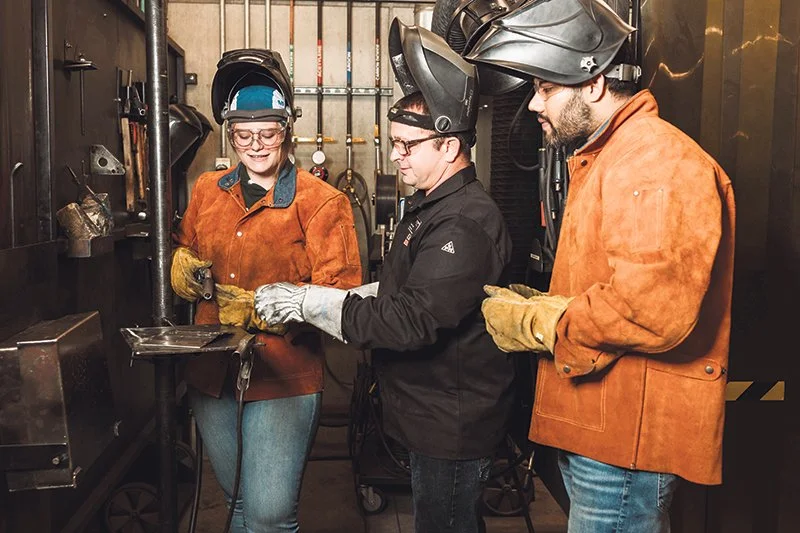
Faccullatum laut aut erferem. Sunt dolore eliqui autent magnim id quam vollabore preicit, quibus quiat et odiorec temporibus ditaspelique ne quas et es su. supplied
The role of skilled trades is changing, and Fleming College is keeping pace. “Our goal is to ensure that the workforce we are creating has the knowledge, skills, and ability to meet industry needs and respond to the government’s call for skilled trades,” says Theresa Knott, interim president.
Students have access to the Kawartha Trades and Technology Centre (KTTC), an 87,000-square-foot, state-of-the-art skills training facility. “We provide an authentic experience to our learners with high-quality education and highly skilled faculty,” says Dr. Knott, while “meaningful relationships with our industry partners” guarantees programs stay current and relevant. The college also offers three apprenticeship programs with nearly 1,000 seats.
To respond to the evolving landscape and the demand for a highly skilled workforce, the college is opening doors to trades careers for younger learners. “We are trying to ignite young people’s learning and desire to go into those fields,” notes Lisa Fenn, dean, School of Trades, Technology & Business. Working with local school boards, Fleming offers multiple dual-credit programs and hosts trade days, where students in grades 7 and 8 participate in experiential learning at the college.
“Our goal is to ensure that the workforce we are creating has the knowledge, skills, and ability to meet industry needs and respond to the government’s call for skilled trades. ”
“We want to build that pipeline for students to start young and begin considering post-secondary and apprenticeships opportunities,” says Ms. Fenn.
Cody Simpson, welding program coordinator at Fleming, says dual credit programs expand access to trades education while supporting inclusive, lifelong learning. Mr. Simpson, a member of the Alderville First Nation, describes how he has come full circle, from learning a trade, working in the field, to becoming a business owner, and returning to a job in education.
“It’s been an awesome experience,” he says. “Fleming’s perspective on pathways provides young students with a buffet of trades,” that can lead directly to post-secondary programs.
And careers in trades are becoming more attractive, he adds. “I think they are finally getting the recognition they deserve.”
At Fleming, the welding program is waitlisted, with an annual intake of 90 students. “We have a robust program that is highly respected by industry,” notes Mr. Simpson. Each spring, the college hosts the Welding Showcase, “a reverse job fair” that draws 35 to 40 industry representatives. Capstone projects demonstrate the skills and techniques students have developed at Fleming.
Companies, ranging from Ontario Power Generation, BWXT, one of Canada’s largest nuclear manufacturers, to smaller firms, recruit new hires, with up to 100 per cent of students securing employment, says Mr. Simpson.
But finding a pathway into the trades is only the beginning. As technology transforms the workplace, Fleming recognizes that tradespeople also need adaptability skills to keep pace with a rapidly changing industry. That is particularly evident in Fleming’s electrical programs, says Rick Murdock, program coordinator, Construction and Maintenance Electrician Apprenticeship Program. “We are presently developing a new curriculum and actively teaching it.”
Students enrolled in electrical programs, which have grown from 60 learners 14 years ago to 400, need broad foundations and the ability to adapt to automation, AI, and new technologies, says Mr. Murdock. Students are learning to work at the intersection of electrical systems, instrumentation, automation, programming and data.
“We’re in the labs all the time, so it’s very hands-on and broad-spectrum,” he says. “You’re not going to leave here an expert in any one thing, but you’ll have a solid knowledge and understanding of a range of skills. In industry, as you move from job to job or situation to situation, you can approach each one with that foundation of knowledge.”
Mr. Murdock recognizes that “automation and machines are deeply affected by AI” and acknowledges the growing importance of AI and machine learning.
However, students will continue to need hands-on experience and problem-solving skills, he says. “I think we’re always going to work on that principle.”
To view this report on The Globe's website, visit globeandmail.com
To view the full report as it appeared in The Globe's print edition Pathways to success