
Tech-forward approach puts humans first
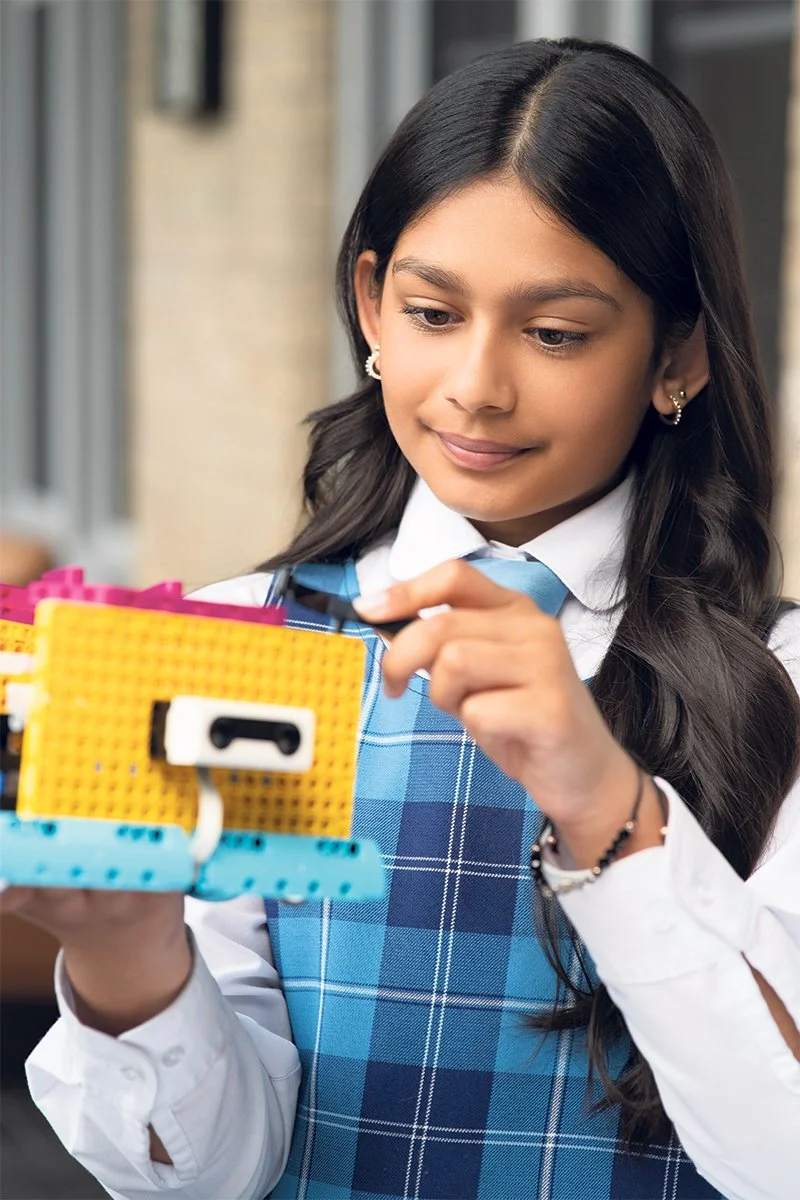
Students at Trafalgar Castle School start engaging in hands-on tech projects in Grade 4, often presented with an environmental or social justice goal or problem, and guided to use technology to address it. supplied
Trafalgar Castle School instills human values into technology studies
Robotics, artificial intelligence (AI), digital design and virtual reality (VR) are among the advanced technologies that students engage with from the earliest grades at Trafalgar Castle School. In an increasingly automated world, the educators at Trafalgar strive to prepare graduates to succeed in the growing number of fields that are infused with technology.
However, Trafalgar recognizes that technological know-how alone is not the key to success. That is why its curriculum is also designed to teach students how to integrate human skills, judgment and values with their use of technology. It is a central philosophy of “tech-forward with humans in the lead.”
“A term sometimes used when working with AI is ‘Human in the Loop.’ That implies a passive role. At Trafalgar, we prefer the concept of being the ‘human in the lead,’ where the individual is the driver of the interaction,” says Laurie Kuchirka, the school’s dean of academics.
By prioritizing human-led design, we give students the agency and confidence to shape how technology solves complex problems. We are teaching them to manage and innovate with these tools rather than simply consuming them.”
Based in Whitby, Ont., Trafalgar educates girls and young women from Grades 4 to 12. Students start engaging in hands-on tech projects in Grade 4, often presented with an environmental or social justice goal or problem, and guided to use technology to address it.
Projects include coding robots to support making a location in the Castle more accessible; using micro:bits to build and code “pollinator counters” to track the number of pollinators in the school’s gardens; or conducting a grocery mission and using math skills to make smart choices based on the needs of a local food bank.
“Focusing on the human lead gives students agency and the confidence to shape how technological tools are used to solve complex problems. ”
While gaining comfort with the technology, the students are also learning that the value of technological tools comes from the decisions that human beings make about how to apply them.
Trafalgar focuses on building future-ready competencies – skills and mindsets to prepare them for the challenges and opportunities they’ll encounter in the real world. These competencies include critical thinking and problem-solving, creativity and design thinking, collaboration, empathy and ethical decision-making, and these human-centred skills are embedded in technology instruction.
When designing a technology application, the first task is to truly understand the needs of the people who will use it, explains technology teacher Penny Senior.
“The first stage of design thinking is empathy, because designers need to know what the user wants the technology to do and why they need it,” says Ms. Senior.
For the accessibility project, students interviewed people with mobility challenges, and then programmed a robot to duplicate wheelchair movements as it navigated through a prototype section of the school campus. Another project with empathy at the forefront involves a partnership with Ontario Tech University, where senior Trafalgar students work with university students to design VR environments suited to the needs of people with dementia.
“Individuals with dementia often feel lonely and can’t leave their environments. The students did multiple iterations to create VR experiences that brought new environments to them, perhaps a travel destination they once loved or creating exercises to work their memory,” Ms. Senior says.
Applying ethics to technology use is a key focus, including for AI. Trafalgar has developed a curriculum plan for all grades that gradually builds students’ skills as critical thinkers and ethical leaders capable of governing AI systems with human agency.
Beginning in Grade 4, teachers guide students to critically assess AI outputs and to recognize bias and errors that may occur because of the data the AI was trained on or the type of questions used as prompts. Students begin using AI in limited ways in Grade 7 and then in more complex ways in higher grades.
“Some research indicates that critical thinking skills can be diminished by interaction with AI,” says Ms. Kuchirka. “Throughout the grades, we guide students to put the human thinking skills first and to use AI as a tool to practise those skills.”
Ms. Kuchirka cites a Grade 10 history project where students prompted AI to describe women’s roles in the 1920s. “The output was generic and reflected the dominant historical narrative of upper-class white women,” she says. “She asked them to follow up the output by asking what about other marginalized groups? To dig deeper to ensure they could make ethical decisions reflecting diverse perspectives.”
As Trafalgar students acquire technological knowledge, they are consistently taught how to put human agency at the forefront and to use technology in a way that is just and fair.
“It goes back to Trafalgar’s vision, which is for a future where every student can ask why and why not – a future where everyone can thrive,” Ms. Kuchirka says. “That means we instill a strong foundation of critical thinking, ethical decision-making and empathy that allows everyone to work together for the common good.”
To view this report on The Globe's website, visit globeandmail.com
To view the full report as it appeared in The Globe's print edition Innovation excellence