
Building sovereignty at sea, anchoring Canada’s defence future
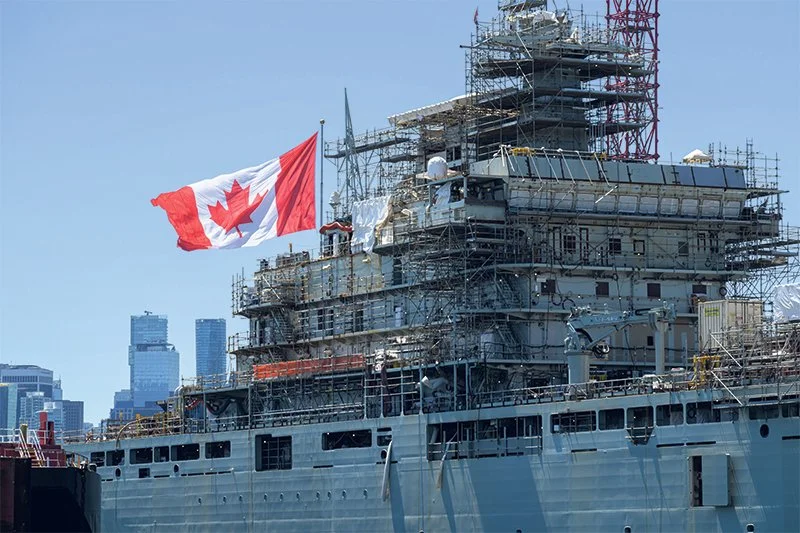
Seaspan is a strategic partner under Canada’s National Shipbuilding Strategy, building large non-combat vessels for the Canadian Coast Guard and Royal Canadian Navy. supplied
As geopolitical tensions sharpen and the Arctic takes on renewed strategic importance, Canada is facing a familiar question with fresh urgency: how to secure its sovereignty in an increasingly contested world. For Leo Martin, who was named chief operating officer of Seaspan Shipyards earlier this year, part of the answer lies not just in what Canada builds, but where – and how – it builds it.
From complex icebreakers capable of operating year-round in the High Arctic to the sustainment of submarine fleets, the Vancouver-based shipbuilder is positioning itself at the centre of a broader national effort to strengthen domestic defence capability.
“We have the largest marine engineering design capability in the country,” says Mr. Martin. “We bring a huge level of competency, both in expertise and execution, in terms of delivering ships to Canada.”
Seaspan is a strategic partner under Canada’s National Shipbuilding Strategy (NSS), building large non-combat vessels for the Canadian Coast Guard and Royal Canadian Navy (RCN). Last year, it delivered the offshore oceanographic science vessel CCGS Naalak Nappaaluk, the fourth-largest vessel and second class of ship to the Coast Guard. Prior to that, Seaspan launched the HMCS Protecteur, the longest naval vessel ever constructed in Canada; it completed the functional design for the first flight of six out of 16 multi-purpose icebreakers (MPIs); and it began work on the Canadian Coast Guard’s (CCG) new heavy polar icebreaker.
“These are some of the most complex and capable vessels in the world,” says Mr. Martin. The company operates Vancouver Shipyards, Vancouver Drydock and Victoria Shipyards, employing approximately 5,300 workers.
“The unique nature of the ships that we design and build here, and their ability to operate in incredibly harsh environments,” is a major asset when it comes to supporting sovereignty and security for Canada, says Mr. Martin. The deployed vessels, which feature cutting-edge technology, provide a needed presence in the Arctic. They can open major transportation routes, providing greater opportunities for the RCN and for the Coast Guard to reach northern communities.
Mr. Martin points out that the mandate of the Coast Guard has undergone significant changes as it transitions to the Department of National Defence: “This is a vision going forward that we will fully support.”
Seaspan will be integral in equipping the Coast Guard for its new role, which includes supporting the RCN through increased reconnaissance and surveillance. “We’re building a fleet for the future that will operate the next 50 plus years for the Coast Guard,” he says.
Seaspan is also at the forefront of submarine sustainment in Canada, says Mr. Martin. “We are already the only proven shipyard in Canada with submarine maintenance expertise. Having that core capability to maintain and ensure the submarine fleet is active and operational on both coasts is absolutely critical to the long-term success for Canadian defence,” he notes.
“We have the largest marine engineering design capability in the country. We bring a huge level of competency, both in expertise and execution, in terms of delivering ships to Canada. ”
Another essential piece is the ability to export Canadian innovation and technology, says Mr. Martin. Seaspan’s designs were recently selected for the production of Arctic Security Cutters, multi-purpose icebreakers for the U.S. Coast Guard. “And the reality is, if we designed it in Canada, we’ve designed it predominantly with a Canadian supply chain, Canadian equipment and Canadian technology,” he says. “It’s a huge win for Seaspan, but also a huge win for the NSS to start to export product.”
Mr. Martin credits the Canadian government, through the NSS, not only with helping to establish a “core sovereign capability to design and build in Canada” but also fostering a robust supply chain.
“When you make a very conscious decision to design complex vessels in Canada, you effectively invest in an ecosystem across the country,” he says.
In addition to its own workforce, Seaspan works with at least 800 Canadian suppliers, including many small and medium-sized enterprises (SMEs) across the country, having a presence in every province.
The delivery of designs and ships is one thing, “but we provide economic value to Canada,” says Mr. Martin. In the first 12 years of NSS, Seaspan contributed about $5.5-billion to the GDP, and he expects that from 2025 to 2035, contributions to the GDP will rise to $14.4-billion.
“We are not only helping to build a more sovereign country, but there is also a macro economic value to the work that we do,” he adds.
To view this report on The Globe's website, visit globeandmail.com
To view the full report as it appeared in The Globe's print edition Advancing Canadian defence and security