
High-school learning aligned with university expectations
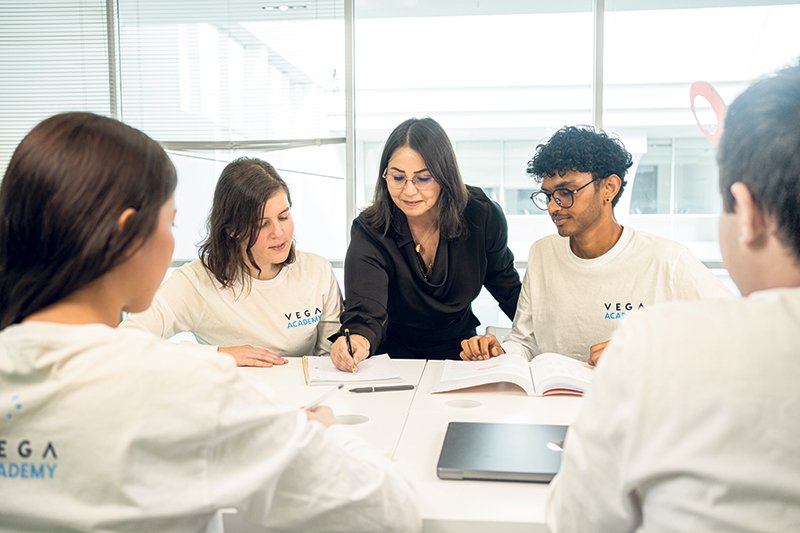
The VEGA Academy-IBU partnership bridges the gap between high school learning and university expectations. supplied
The transition between grade 12 and first-year university can be challenging due to a long-recognized gap learners have to navigate on their journey to post-secondary success. The rapid rise of AI has further exacerbated this chasm: at a time when students can generate instant answers, the ability to reason, verify and refine their work with integrity has become all the more crucial.
The simple goal – to bridge this gap – sparked the creation of a unique pathway, a partnership of VEGA Academy and International Business University (IBU), which “enables high school students to develop durable skills, strong judgment and portfolio-quality work before they arrive at a university campus,” says Miguel Lameiro, principal, VEGA Academy.
“Seeing a persistent disconnect between what traditional schooling rewards and what students truly need to thrive beyond high school – including skills like resilience and ownership of their thinking – led us to create a model built on inquiry, real-world cases and meaningful projects.”
“Seeing a persistent disconnect between what traditional schooling rewards and what students truly need to thrive beyond high school – including skills like resilience and ownership of their thinking – led us to create a model built on inquiry, real-world cases and meaningful projects. ”
The VEGA Academy-IBU pathway emerged as a practical response: an opportunity to give students structured, earlier exposure to university-level expectations while keeping high school learning aligned with ministry standards, he explains. “It gives high school students a smoother transition into first-year university life – so they step onto campus with confidence and a strong sense of readiness.”
The dual-credit program aligns with Ontario’s Ministry of Education curriculum, weaving in early exposure to university-level thinking, academic habits and subject-area depth without compromising rigour or required outcomes.
A skills-focused science, technology, engineering, arts and math (STEAM) curriculum prepares students “for a world where knowledge alone isn’t enough,” says Mr. Lameiro. “Today’s learners must be able to think across disciplines, frame complex problems, work with evidence and communicate decisions clearly.”
With technology – and particularly AI – reshaping how information is created and evaluated, students need strong habits of verification, critical reasoning and ethical use of digital tools.
The program offers “ethical AI literacy, which is taught as an integrated academic discipline focused on planning, verifying, questioning and refining, so students keep ownership and integrity in their work,” he notes. “Career landscapes are also shifting quickly, making adaptability and entrepreneurial thinking essential.”
Small classes and high-touch coaching ensure students receive individualized attention and personalized support, “and a curated showcase portfolio collects high-quality evidence of mastery,” adds Mr. Lameiro. “The VEGA Academy Learning Experience [VALE] is an inquiry-first approach where students tackle real problems, analyze evidence, defend conclusions and strengthen their work through feedback.”
Dual-credit opportunities are being aligned with IBU courses in areas like leadership, international business and critical thinking: a philosophical perspective, to help students build the judgment and durable skills first-year success requires, he notes, and the wide range of senior courses in math, sciences, humanities and business mean that “students can go on to pursue programs at IBU or any other post-secondary pathway.”
From the recognition that academic success is an important – but not the only – component allowing students to thrive, the “partnership is intentionally designed to extend beyond academics through the Vega Academy Co-Curricular Experience [VACE],” says Mr. Lameiro. “This supports students’ social integration, confidence-building and sense of belonging as they prepare for postsecondary study.”
Through the partnership, select senior courses are mapped to first-year university expectations and supported by faculty micro-lectures, case-based learning, mentorship and on-campus experiences. In addition, Mr. Lameiro says, “each VEGA Academy student is paired with an IBU ‘North Star’ mentor, a current university student who provides cultural, academic-adaptation and emotional guidance, helping students navigate life and learning in a university-connected environment.”
Students also benefit from access to IBU peer tutoring, participation in selected IBU networking and community events, and experiential learning opportunities that mirror university expectations for independence and engagement.
“Through VACE, the academic preparation is reinforced by structured co-curricular supports: mentorship, peer tutoring, experiential learning and engagement to address the social and adaptive dimensions critical to post-secondary persistence and success,” he adds.
While VEGA Academy is still in its growth and launch phase, Mr. Lameiro has already noticed meaningful early impacts, namely how students are building valuable habits.
“They are gaining skills that are directly tied to post-secondary success. Students are learning how to think more independently, manage complex tasks and demonstrate mastery through portfolio-quality work,” he says. “By engaging in sustained inquiry, project-based learning and case-driven work, students repeatedly practise designing, testing, refining and reflecting.”
The result? A portfolio of tangible, durable skills that illustrates what can be achieved when high school learning is better aligned with both university expectations and the demands of a rapidly evolving workforce.
To view this report on The Globe's website, visit globeandmail.com
To view the full report as it appeared in The Globe's print edition Business education in Canada