
Improving outcomes through research: genetic clues and what they reveal about heart health
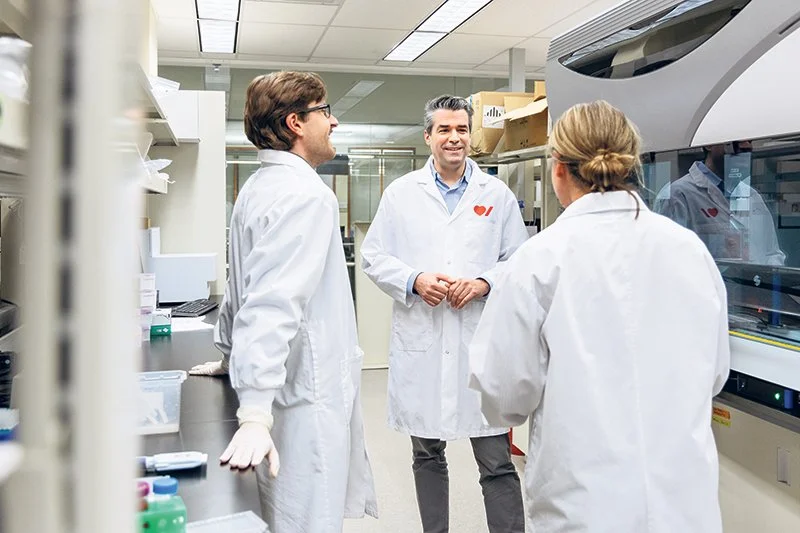
What can your genes tell you about your and your family’s risk for heart disease? And how can such insights lead to early interventions and better health-style choices? These are some of the questions investigated by research funded by Heart & Stroke and led by Dr. Guillaume Paré. HEART & STROKE
February is Heart Month. And the conversation about heart health isn’t just timely, it is urgent. After all, more than half of Canadians are personally impacted by heart disease or stroke, according to a 2024 Heart & Stroke poll.
“The impact of heart conditions and stroke is very substantial,” says Dr. Ryan Perry, vice president of research at Heart & Stroke, the largest funder of cardiovascular research after the federal government. “More than six million people in Canada are living with heart disease and stroke. Nearly one in five deaths in Canada are caused by heart conditions; and heart conditions cost the Canadian economy more than $21.2-billion per year.”
Despite the stark numbers, breakthrough advances have translated into better outcomes for Canadians. For example, the death rate from heart disease and stroke has declined by more than 80 per cent over the past seven decades since the inception of Heart & Stroke.
“While incredible progress has been made, more efforts are needed,” says Dr. Perry. “As our population ages and more young people experience heart disease and stroke, the need for research grows more urgent. We have to pay attention to not only managing these conditions but also to predicting and preventing them.”

“Polygenic risk is the combined effect of smaller genetic variants. Alone, these variants increase the risk of heart disease by just a tiny bit. In combination, they put people at very high risk. ”
From understanding genetic factors to timely interventions
In its 2025 fiscal year alone, Heart & Stroke funded the work of 1,059 of Canada’s top researchers, trainees and contributors, working on the front lines to beat heart disease and stroke.
Among them is Dr. Guillaume Paré, senior scientist, Population Health Research Institute, a joint institute of McMaster University and Hamilton Health Sciences, who is combing through millions of genetic clues to identify who is at risk for heart disease and how to save them.
His work is inspired by seeing people in their 30s and 40s blindsided by severe heart attacks, with no obvious cause.
“Heart disease is catastrophic at any age, but it’s particularly striking in younger individuals,” Dr. Paré explains. “Oftentimes, these people have young children, active careers and so much to live for. And if someone has a first heart attack in their 30s or 40s, we know we’re facing an aggressive disease that is very likely to strike again.”
Asking these patients about their family history led to the assumption that the cause of their condition must be genetics. “And yet, we didn’t find anything striking when we looked at their individual genes,” says Dr. Paré, adding that an early focus on a single mutation, familial hypercholesterolemia, revealed gene mutations explained only two to five per cent of the cases.
By looking beyond a single gene or mutation, Dr. Paré and his team pioneered polygenic risk scoring – a method that estimates a person’s genetic predisposition to a disease or trait – and a breakthrough discovered in 2018.
“The risk for these young people having a heart attack may not be due to one significant gene mutation, but rather a very large number of genes with very small mutations,” he says. “Polygenic risk is the combined effect of smaller genetic variants. Alone, these variants increase the risk of heart disease by just a tiny bit. In combination, they put people at very high risk. It’s a way to capture hereditary risk – the impact of hundreds or thousands of tiny genetic variants on heart health – in a single number.”
There are significant advantages to being able to identify people at high risk for early-onset heart disease, potentially decades before disease strikes, says Dr. Paré, who envisions “identifying polygenic risk and treating it more aggressively with safe and effective interventions.
“Obviously, genetics are very important, but it’s the combination of genetics and how we live that truly determines our risk: our environment, our lifestyle, our diet, how we exercise, and whether we smoke or not,” he notes. “We’re doing a lot of research on gene–environment interactions, which ties back to the idea that heart disease isn’t just your destiny, even if you have genetic risk.”
Since the discovery, polygenic risk scoring has been widely adopted and refined by other groups working in other fields, such as cancer, diabetes and dementia. Dr. Paré and his team work on many projects that align with the broader mission of improving heart and brain health, including investigations of the link between heart disease and accelerated aging, new methodologies for pharmacogenetics, and how blood biomarkers can be used to predict mortality.
“Heart & Stroke funding has made it possible for me to pursue research that would simply not exist without this support,” he says. “Knowing that these funds come directly from the generosity of donors makes the work feel even more meaningful and deeply connected to the patients and families we aim to help.”
An impressive track record of supporting heart health
Dr. Perry credits donor support with having enabled Heart & Stroke to invest $1.73-billion in world-class heart and brain health research.
The organization also has a strong track record in leading advocacy and systems change efforts that have changed the way we prevent, diagnose and treat heart disease and stroke and support recovery.
“Donations allow us to invest in the best possible people and the best possible science,” he says. “Donor support is the fuel that drives research forward, enabling discoveries and life-saving solutions to take shape.”
According to a 2024 Heart & Stroke poll, 99 per cent of Canadians agree it is important that there be more research on heart disease/conditions, stroke and vascular cognitive impairment, including their causes, diagnosis, treatment and care.
“Driving change is possible by catalyzing the generosity of donors and the passion of researchers and advocates,” adds Dr. Perry. “Together, we can reduce the impact heart disease and stroke have on the lives of Canadians.”
To help fuel more breakthroughs, visit heartandstroke.ca.
To view this report on The Globe's website, visit globeandmail.com
To view the full report as it appeared in The Globe's print edition Heart Month