
Leadership-focused business education

GETTY IMAGES.COM
Shaminder Singh Parmar can trace a direct line between his fulfilling career as a senior urban planner for Edmonton Public Schools and his MBA studies at the Thompson Rivers University (TRU) Bob Gaglardi School of Business and Economics.
Eight years ago, Mr. Parmar foresaw the impending retirement of several senior planners at Edmonton Public Schools. He was 30 years old at the time and working one level lower than his role today. He knew he needed to be able to step up when the tenured planners left.
“I was thinking ahead to having to negotiate with big-time developers, builders and the city to advocate for better public school sites and neighbourhood design for families and kids, and I didn’t feel I had enough knowledge about finances, negotiating and business,” recalls Mr. Parmar, who was named last year among Edmonton’s Top 40 under 40 by Edify magazine. “So I decided I would up my game so I can better negotiate and advocate on behalf of public schools, and an MBA was going to be the tool to help me do that.”
Despite the 810-kilometre distance from his home, Mr. Parmar chose TRU Gaglardi – located in Kamloops, B.C. – as his MBA school. Today, he’s one of almost 22,000 graduates of TRU Gaglardi, named after Kamloops-born entrepreneur and billionaire Bob Gaglardi, who gave TRU a $10-million gift in 2022 to support business education.
Trent Tucker, associate professor and MBA faculty program coordinator at TRU Gaglardi – which launched its MBA program in 2005 – says what sets the school apart from many others is its “classic MBA” model that delivers general management education across core business domains rather than a program aimed at a single professional track.
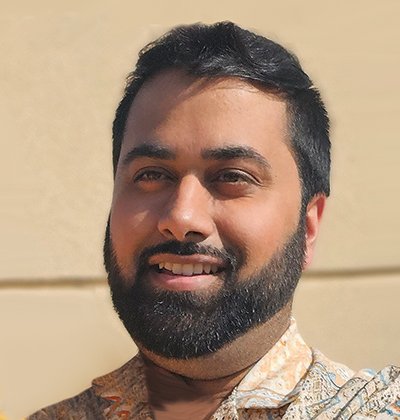
“So I decided I would up my game so I can better negotiate and advocate on behalf
of public schools, and an MBA was going to be the tool to help me do that. ”
“A classic MBA is business school education for people who are interested in a broad spectrum of general management courses – a little bit of accounting, a little bit of HR, a little bit of marketing, some supply chain and operations management,” he says.
That breadth draws students from outside traditional business backgrounds – including engineering, IT, medicine and public-sector roles where leaders increasingly need financial fluency, negotiation skills and strategic decision-making.
“Our program is designed to serve emerging and experienced professionals who want a rigorous, broad-based business education without the traditional barriers of geography or rigid scheduling,” says Dr. Tucker, noting that the TRU Gaglardi MBA caps class sizes at 36 students to maintain high-quality interactions among students and with instructors.
Flexibility is key. TRU Gaglardi students can learn completely online, on campus, or in a hybrid format. Part-time study options, online or on-campus, are available, and recent graduates from recognized business degree programs in North America may be eligible for TRU Gaglardi’s accelerated one-year MBA program.
“I liked how I was able to do everything online – the only time I went to Kamloops was for my graduation,” says Mr. Parmar. “That wasn’t the case with many of the other schools, which had stipulations like having to come in-person for summer class for three weeks.”
He also appreciated the program’s course-based structure, with the option to work on a graduate project that addresses a real-world management issue, or to pursue a research pathway.
He chose the latter, using his MBA work to explore how social-mission organizations respond to austerity and disruption. That research informed a more collaborative approach to early infrastructure planning, where time, expertise and resources are shared upfront and community groups and future users are engaged alongside builders, developers and the city. This has reduced reliance on costly, reactive measures later on.
“I really appreciated that kind of practical focus and being able to explore something in real time,” says Mr. Parmar.
TRU Gaglardi’s flexible program delivery – combined with thoughtful guidance from faculty and staff – turned out to be even more critical than he initially thought. COVID hit while Mr. Parmar was in the program. Since then, he had two children – one after the other – and bought a house.
Mr. Parmar says the school’s faculty and advisers helped him figure out how to continue his studies throughout all these events. He finished in 2025.
“Because of all the learnings I had achieved through the program, I was able to advance to a senior planner position, which means I’m now entrusted to make high-level decisions related to finance and strategic planning,” says Mr. Parmar. “I feel very comfortable in this role. Before the MBA, I had less confidence around the business and financial aspects of the work, and the program helped close that gap.”
To view this report on The Globe's website, visit globeandmail.com
To view the full report as it appeared in The Globe's print edition Skills for a sustainable future