
Tackling ‘one of the defining challenges of our time’ with multi-pronged solutions
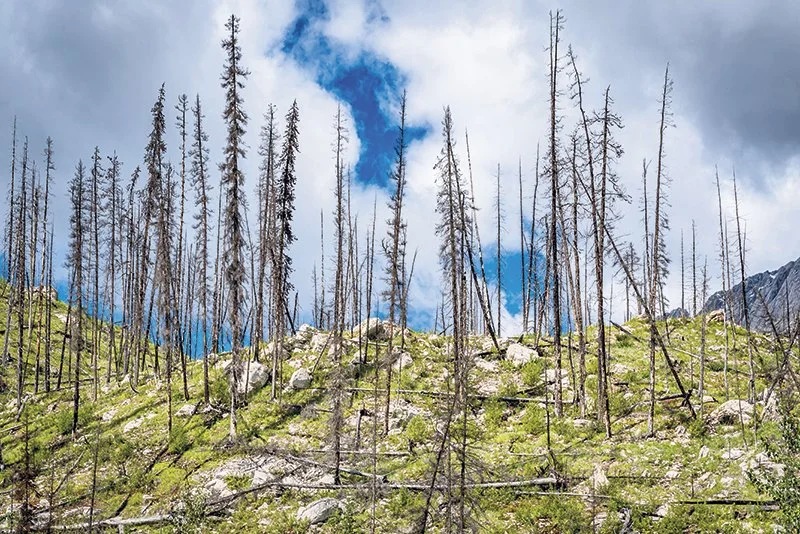
An increasing prevalence of fire weather is leading to a longer – and more intense – fire season. TRU Wildfire is catalyzing collaborations that look at the entire spectrum: from prediction and preparedness to response and recovery. supplied
The recipe for wildfire – which applies everywhere on Earth – requires three ingredients: vegetation (fuel), ignition and conducive fire weather. While all three are subject to change, trends in extreme fire weather cause particular alarm. In Canada, the average area burnt annually by wildfires has quadrupled since the 1970s. In the past three years alone, almost 8 per cent of the country’s forests have burned.
As Canada experienced “three bad fire years in a row, there have not been enough resources for about two-thirds of the days in our fire season,” says Mike Flannigan, BC Innovation Research Chair in Predictive Services, Emergency Management and Fire Science at Thompson Rivers University (TRU). “What we’re facing requires a proactive approach that spans prevention and mitigation, preparedness, response and recovery.”
Addressing the abrupt increase in wildfire activity – and associated consequences for the environment, communities and health – starts with “a better understanding of fire behaviour and risk factors, and for that, research is key,” he says, explaining that this is part of the value proposition of TRU Wildfire, a centre for wildfire research, education, training and innovation.
“Rather than this being the topic of the day
when wildfires happen, there needs to be recognition that this is one of the wickedest problems we’re facing
as a society. ”
“Wildfire is one of the defining challenges of our time,” says Dr. Airini, president and vice-chancellor of TRU. “Solutions are found in use-inspired research that brings together scientists, practitioners and communities to generate innovations that can be applied on the ground and make a real difference, and that’s exactly the role TRU Wildfire is designed for.”
Evidence shows that changing weather patterns influence all three ingredients for wildfire, where the third factor – fire weather – “can be particularly problematic,” says Dr. Flannigan. “In Canada, 3 per cent of fires burn 97 per cent of the total area. Much of this happens when we get hot, dry and windy conditions, leading to higher intensity fires that can be difficult to extinguish.”
The increasing prevalence of such fire weather is due, “in large part, to human-caused climate change,” Dr. Flannigan adds. “The warmer it gets, the longer the fire season lasts and the more fires we see.”
A challenge of this scale requires sustained attention and partnerships, proposes Shannon Wagner, TRU’s vice president, Research. “Rather than this being the topic of the day when wildfires happen, there needs to be recognition that this is one of the wickedest problems we’re facing as a society.”
In addition to continued efforts to advance research and education, the university works to raise awareness at provincial, national and international levels to keep the “discussion about fire in the landscape and the wildland-urban interface at the forefront,” she says.
Building on a foundational partnership with BC Wildfire Service (BCWS), TRU Wildfire brings together “faculty, students, practitioners and other stakeholders with an emphasis on interdisciplinarity,” says Dr. Wagner. “The vision is to create an ecosystem where leaders in this space can collaborate – and to create a clear pathway to develop the leaders of tomorrow.”
TRU Wildfire’s scope is deliberately inclusive, because “there is no silver bullet for addressing wildfires,” Dr. Flannigan emphasizes. “This is a multifaceted issue – and we need multi-pronged solutions. What is needed is an updated wildfire strategy, where we work hand in glove with federal, provincial and municipal agencies and with local communities, and this requires partnerships, networking and building trust.”
Close collaborations with practitioners like BCWS create a crucial feedback loop for the development and validation of solutions, he says. “Firefighters make life-and-death decisions, so they don’t add new things to standard operating practice lightly. They test them thoroughly to determine whether they are sound and improve outcomes.”
There is consensus that rapid detection is key, especially for extreme fire conditions, says Dr. Flannigan. “B.C. has a great app, where you can take a picture on your cell phone and geo-locate it. From there, we need a decision-support system to determine which fires to fight and which to monitor, and how many resources to send.”
Resource allocation can also be enhanced by predictive capabilities. “Our research looks at improving on the accuracy of weather forecasts – and using tools like machine learning and artificial intelligence to create predictive models for fire occurrence,” he notes. “When you see extreme fire weather coming, you can move sufficient resources to where they will be required.”
For the prevention and preparedness aspect, “there is also room for improvement in being more proactive, for example, in making community infrastructure more resilient with the FireSmart program,” says Dr. Flannigan.
For TRU, engagement at the community level can help raise awareness as well as draw on local and Indigenous knowledge.
The idea is to have “our predictive scientists work with community scientists and Indigenous partners, so we can look at the entire spectrum from prediction and preparedness to response and recovery,” says Dr. Wagner, adding that TRU looks to share knowledge gleaned from these collaborations to contribute to wildfire resilience across Canada and internationally.
“There is increasing recognition that B.C. and Canada are not in this alone. We are part of the response to what is a global challenge,” says Dr. Wagner, who notes that TRU is involved with the global fire management hub at the UN Food and Agriculture Organization.
“This [initiative] really stands out, both for the partnerships we developed and the insights we’ve gained.”
To view this report on The Globe's website, visit globeandmail.com
To view the full report as it appeared in The Globe's print edition Wildfire resilience