
Translating AI Science to Solve Humanity’s Toughest Challenges
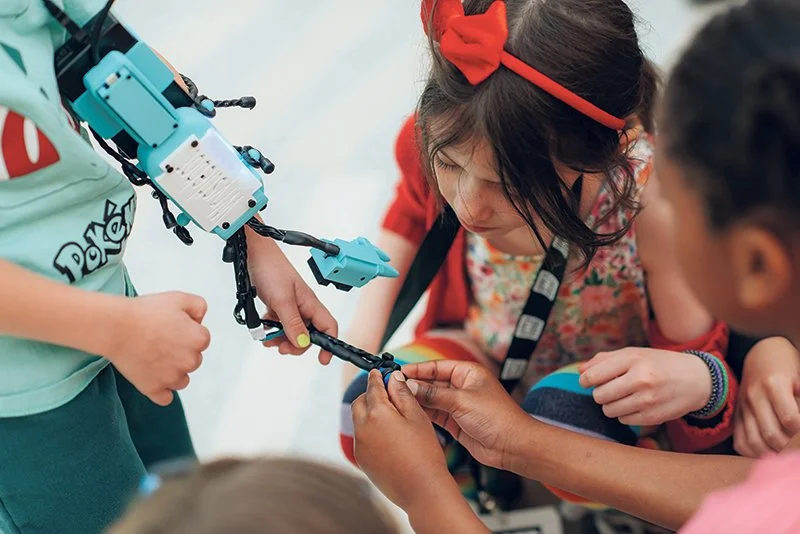
AI-powered prosthetic limbs adapt to their users. supplied
Amii turns breakthroughs into meaningful action, deploying responsible technology to benefit our health, environment and communities
In a remote community, safe drinking water often relies on a technician who might only visit once a month. In a busy emergency room, a physician struggles to make eye contact with a patient while frantically typing notes.
These are the types of everyday challenges experts at Amii (Alberta Machine Intelligence Institute) are using artificial intelligence technology to address – and it’s making a big difference.
“When we think about the societal benefit of AI, it’s not only economic impact and productivity,” says Stephanie Enders, Amii’s chief delivery officer. “It’s also about incremental improvements that make our daily lives better.”
Ms. Enders says Amii’s mandate – AI for good and for all – is a philosophy that moves beyond the theoretical into tangible, human-centric applications. This approach has positioned the Edmonton-based institute – one of three national AI centres– as a steward of responsible innovation.
The results are already visible in Alberta’s health care system. Dr. Ross Mitchell, an Amii research fellow, has developed an “ER scribe” tool that uses large language models (LLMs) to transcribe and structure medical notes during patient consultations.
The primary goal isn’t just efficiency; it’s also the restoration of the human connection in medicine. By automating the rigorous documentation required by electronic medical records, the system frees doctors to look at their patients rather than their screens.
“It saves them a significant amount of time,” Ms. Enders explains. “But more importantly, it means they are looking at a patient during the meeting.”
A similar philosophy drives the work of Dr. Patrick Pilarski, another Amii fellow and co-lead at the BLINC Lab (Bionic Limbs for Improved Natural Control). His team uses reinforcement learning – a type of AI that learns through trial and error – to create AI-powered prosthetic limbs that adapt to their users. Instead of a person with limb loss having to learn complex commands to operate a prosthetic arm, the arm learns the user’s intent and environment.
The institute’s work also extends to environmental and social challenges through the work of Amii fellows Martha and Adam White, co-founders of RL Core. With support from Google’s philanthropic arm, the RL Core co-founders, alongside Amii, have proven success that AI can manage key processes within water treatment facilities in remote communities for two-week cycles without human intervention. This achievement offers a valuable lifeline for isolated regions where chronic technician shortages often jeopardize access to clean water.
Meanwhile, Calgary-based ZeroSound collaborated with Amii to bring reinforcement learning to revolutionize industrial safety. Unlike traditional noise cancellation that relies on static averages, their AI-driven panels adjust in real-time to shifting noise. Achieving an approximate 15-decibel reduction in test environment settings, potentially making hazardous environments like factories and busy intersections sound 60 per cent quieter for workers once scaled to larger deployments.
Ms. Enders emphasizes that “AI for all” also means ensuring the technology is safe and inclusive.
To ensure these technologies remain safe, Amii has established a dedicated AI Trust & Safety Team who collaborate with the federal government’s new Canadian Artificial Intelligence Safety Institute (CAISI) and fellow national AI institutes Vector and Mila to advance AI safety research and define global standards for safe and secure AI systems.
For Ms. Enders, the ultimate measure of success isn’t just a smarter algorithm, but a better society.
“Big statements like ‘AI for good’ can sound ephemeral,” she says. “But what I love is that we bring it to a really tangible place.”
To view this report on The Globe's website, visit globeandmail.com
To view the full report as it appeared in The Globe's print edition AI and science innovation